
Someone on your team has probably said it already. “Why don’t we just use AI to find leads?” Maybe you’ve said it yourself. It sounds reasonable. AI is everywhere now. You can ask it to write emails, summarize reports, generate images. Surely it can find you some companies to sell to.
It can. Sort of. And that “sort of” is where the trouble begins.
Let’s start with what AI actually is — in plain terms. When people say “AI” today, they usually mean large language models. Think ChatGPT, Gemini, Claude. These systems have read enormous amounts of text and learned to predict what comes next in a sentence. That’s a simplification, but it’s the core idea. They’re extraordinarily good at understanding language, recognizing patterns, and generating text that sounds intelligent and confident.
But here’s the thing most people don’t realize: sounding confident and being correct are two completely different things.
Ask a language model to find ten companies in the Netherlands that would be a good fit for your cloud security product, and it will happily give you ten names. They’ll sound plausible. The reasoning will be convincing. But when you actually check, you might find that two of those companies went bankrupt last year, one doesn’t operate in the Netherlands, and another already uses a competitor’s product and is locked into a three-year contract.
The AI wasn’t lying. It was doing what it always does — generating the most plausible answer based on patterns. It doesn’t browse the internet in real time. It doesn’t verify facts against a database. It doesn’t know what happened last Tuesday. It produces text that looks right, and most of the time that’s useful. But when you’re making business decisions about where to invest your sales team’s time, “looks right” isn’t good enough.
This is the gap that most people discover after a few weeks of experimenting. The initial excitement fades. The inconsistencies pile up. And you realize that using AI for prospecting isn’t a matter of asking the right question — it’s a matter of building an entire system around the AI to make sure its answers are actually reliable.
That system is what took us years to build. Not the AI part. The everything-else part.
Here’s what ProspectsRadar actually does, step by step, in terms anyone can follow.
First, it learns what you sell. Not just the product name or a one-line description. It builds a detailed understanding of your offering — what problems it solves, who it’s for, what makes it different from alternatives, how it’s priced, what kind of company would genuinely benefit from it. This matters because finding good prospects isn’t about finding companies in the right industry with the right number of employees. It’s about understanding fit at a much deeper level.
Then it goes looking for companies that match. This is where most people assume you can just ask AI to do the work. And you can — but only if you orchestrate multiple AI systems together and verify everything they produce. ProspectsRadar doesn’t use a single AI model. It uses specialized agents, each responsible for one part of the process. One agent generates search terms based on your product profile. Another searches for companies using those terms. A third gathers factual data about each company — size, industry, technology they use, recent news. A fourth enriches that data from multiple sources. And a fifth evaluates the results.
Every agent checks the work of the one before it. This is critical. If you’ve ever used ChatGPT for research, you know that a single AI can go off track without warning. By breaking the process into stages and having each stage validate what came before, inconsistencies get caught early. Hallucinated companies get filtered out. Outdated information gets flagged. What reaches you at the end has been through multiple layers of verification.
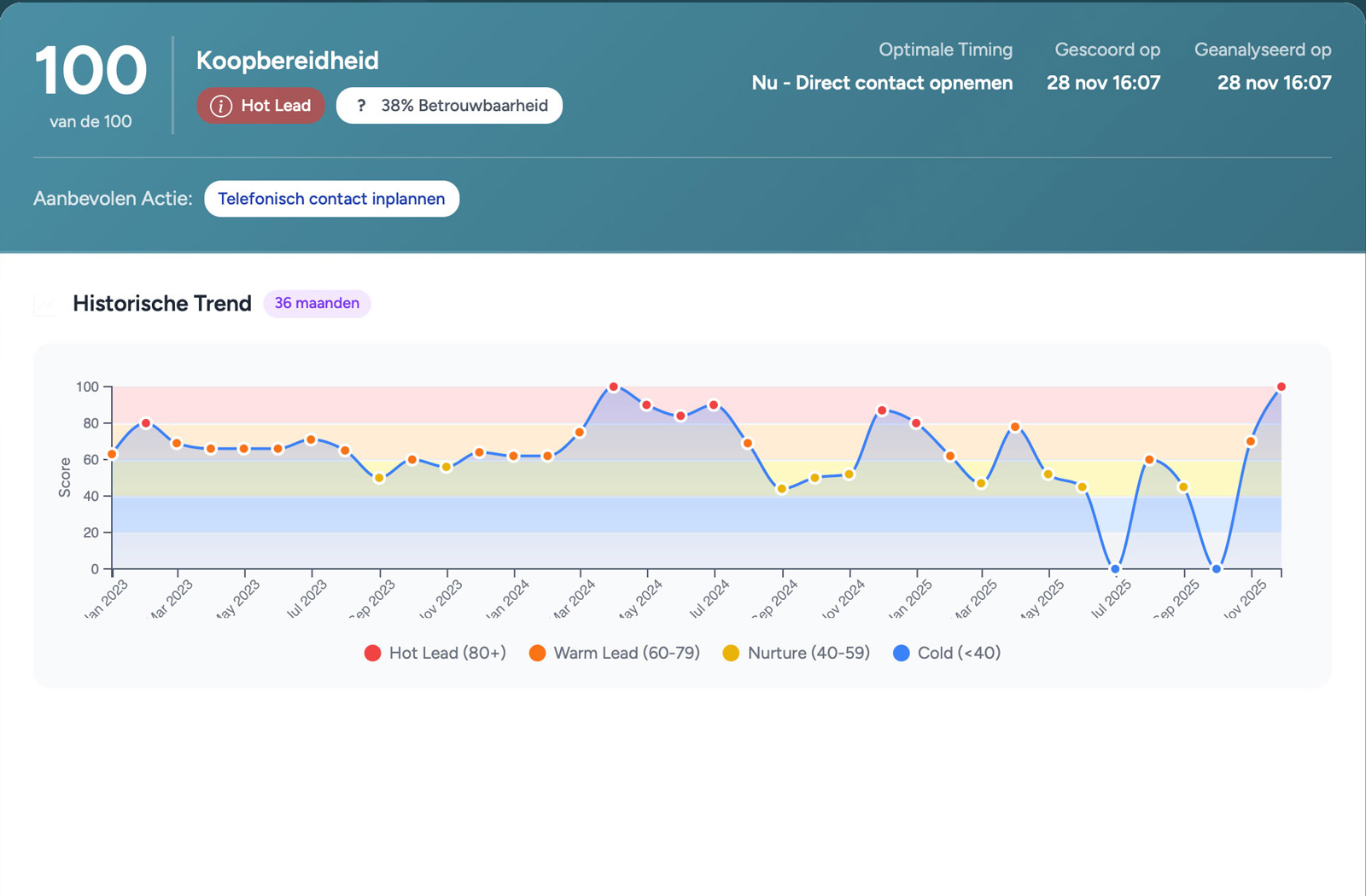
ProspectsRadar then evaluates every prospect across six dimensions — product-market fit, market size potential, competition level, entry difficulty, revenue opportunity, and strategic alignment. Each dimension gets a score. But more importantly, each score comes with an explanation. Not a number in a black box. An actual reason, in plain language, for why this prospect scored the way it did. A score of 82 means nothing if you don’t know why it’s 82. But when the system tells you “this company recently migrated to a cloud infrastructure that your security product directly supports, they’re hiring a CISO which suggests security is becoming a priority, and they have no known relationship with a competing vendor” — now you have something you can act on.
But finding and scoring the right companies is only the beginning. This is something we learned the hard way. You can have a list of fifty companies that are a perfect match for your product, and still get nothing but silence when you reach out. Why? Because fit and timing are not the same thing.
A company might be an ideal customer for what you offer. But if they just signed a contract with a competitor last month, they’re not buying. If they’re in the middle of a reorganization, your email is going to the bottom of someone’s inbox. If the budget cycle doesn’t start until Q3, no amount of persuasion will move things forward in Q1.
This is why ProspectsRadar doesn’t just find matching companies and hand them to you. It watches them. Continuously. Across ten different categories of signals. Is the company hiring for roles that suggest they need your type of solution? Has there been a change in leadership — a new CTO or VP who might reassess existing tools? Have they received funding that gives them budget for new investments? Are they posting about challenges that your product directly addresses? Has their technology stack shifted in a way that creates an opening?
Each of these signals is detected, verified, and scored — not by one AI guessing in the dark, but by a purpose-built system that searches the real web, checks sources, and assigns confidence levels. Signals below a reliability threshold are discarded. The ones that survive get added to what we call the prospect’s Timeline — a living, continuously updated history of everything that matters about that company.
Think of the Timeline as the story of a prospect unfolding in real time. Every verified signal — a job posting, a funding round, a leadership change, a blog post about a challenge your product solves — appears on the timeline with a date, a source, and a confidence score. But it goes further than just collecting events. The system analyzes what those events mean together. A single job posting for a DevOps engineer is a data point. But when that job posting appears alongside a recent cloud migration announcement, a new VP of Engineering appointment, and a blog post about scaling challenges — that’s a pattern. ProspectsRadar detects these compound patterns automatically and surfaces them as distinct insights. It tells you not just what happened, but what those things mean when you connect them.
The Timeline also tracks how a prospect’s readiness evolves over time. You can see when they moved from cold to warm, what triggered the shift, and whether the trend is improving or declining. If a risk appears — say, the company announces a hiring freeze or a merger — that shows up too, along with a suggested way to adjust your approach. Everything flows into a single view, grouped by date, so your sales team can glance at a prospect’s timeline and understand the full picture in thirty seconds. No digging through ten different tabs. No piecing together fragments from LinkedIn, news sites, and CRM notes. One timeline. Everything verified. Everything in context.
And here’s what ties it all together: you don’t sell to companies. You sell to people. In B2B, a purchasing decision almost never rests with a single person. It typically involves three to five people — sometimes more — each with a different role in the process. There’s the person who signs the contract. There’s the person who whispered in their ear that a problem needs solving. There’s the team lead who will evaluate your product against alternatives. And there’s the person who will actually use it every day and whose opinion carries more weight than anyone’s title suggests.
ProspectsRadar maps this entire decision-making unit automatically. It identifies the key roles needed for your specific type of product — because the buying committee for a cybersecurity tool looks very different from the one for a marketing platform — then finds the actual people in those roles at each prospect company, gathers their professional background, and classifies them into three tiers. Tier one: the decision makers with direct purchasing authority. Tier two: the influencers who shape the decision, who get asked “what do you think?” before anything gets signed. Tier three: the end users who will work with your product daily and whose enthusiasm or resistance can make or break a deal.
Most outreach fails at exactly this point. You find the right company, you craft a great message, and you send it to the wrong person. Or you reach the right person but have no idea who else needs to be convinced. ProspectsRadar gives your sales team the full map before the first conversation happens — who to approach first, who to loop in next, and who holds the final decision. Each person comes with verified contact information and is linked to the timeline, so if the new CTO you’re about to email is the same person who triggered a leadership change signal last month, you know that before you pick up the phone. The context is already there.
Now, here’s why this is not something you can replicate with a ChatGPT subscription and a free weekend.
Every piece of this system — the multi-agent pipeline, the cross-verification, the signal monitoring, the timeline intelligence, the readiness scoring, the decision-maker mapping — those are all separate engineering problems. Each one took months to solve. The AI itself is maybe twenty percent of the work. The other eighty percent is the infrastructure that makes the AI trustworthy: the validation rules, the confidence thresholds, the source verification, the feedback loops that catch errors before they reach a human.
We’ve seen people try to build this themselves. Smart people. They get the first ten percent working in a weekend and feel invincible. By week three, they’re drowning in edge cases. By month two, they’ve realized that maintaining a reliable AI pipeline is a full-time job — one that has nothing to do with selling.
This is what ProspectsRadar gives you back: your time. Instead of spending your week building and debugging an AI system, you spend it having conversations with prospects who are actually ready to hear from you. Instead of guessing which companies to call, you open your dashboard and see who’s showing buying signals right now. Instead of writing cold outreach to strangers, you’re reaching out to people whose situation you already understand — and you know exactly who at that company to talk to.
The AI does the heavy lifting. But it does it under strict supervision, through verified channels, with multiple checkpoints — so what reaches your screen is something you can trust.
That’s the difference between using AI and having a system built around AI. One gives you plausible guesses. The other gives you reliable intelligence.
We know which one we’d rather build a business on. And we think you do too.